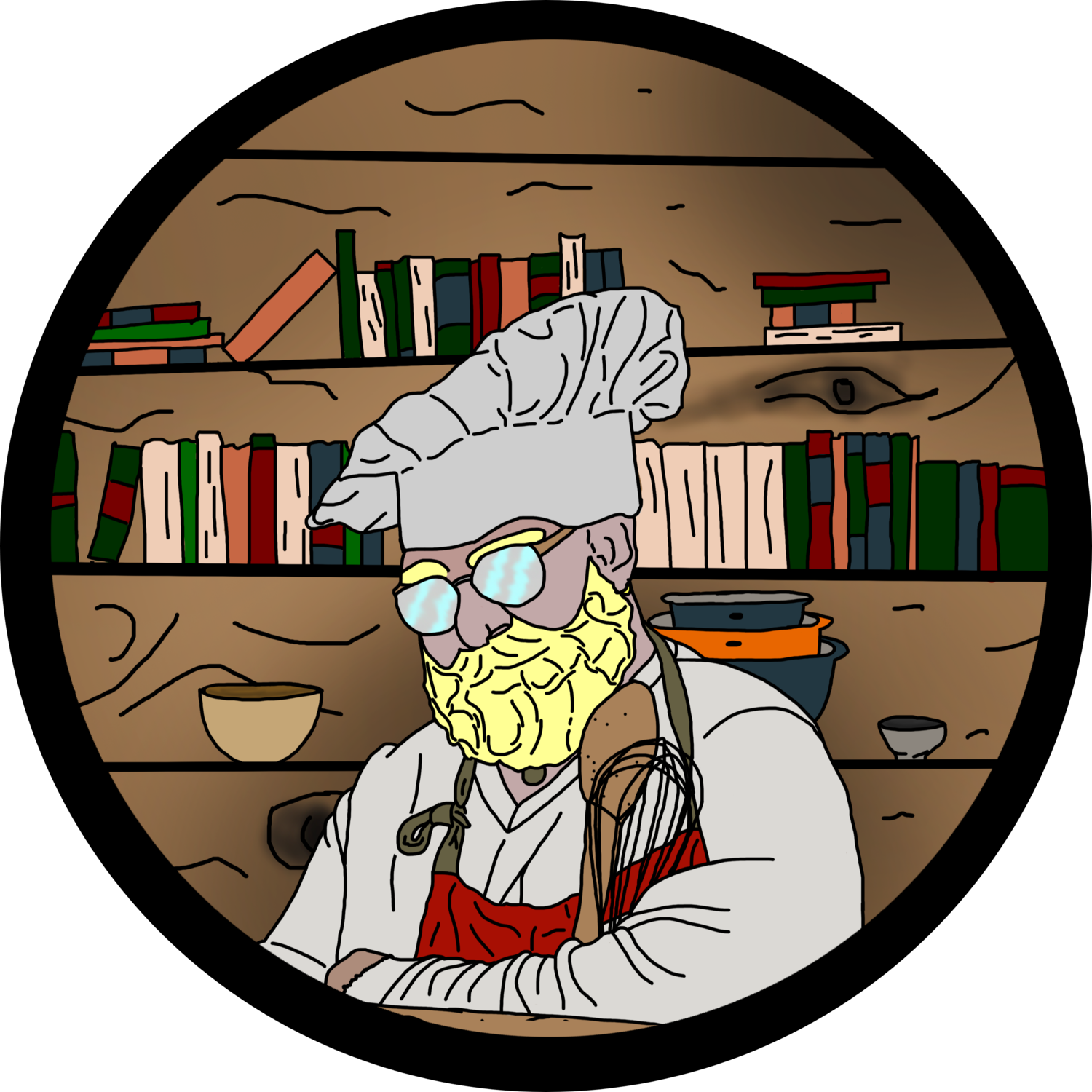
Professor Butter Beard and the “House of Holbein”
“You bring the corsets
We'll bring the cinches
No one wants a waist over nine inches
So what the make up contains lead poison?
At least your complexion will bring all the boys in
Ignore the fear, and you'll be fine
We'll turn this vier into a nine
So just say "ja" and don't say "nein"
'Cause now you're in the house
In the Haus of Holbein!”
- Lucy Moss and Toby Marlow, “Six, The Musical”
Yup, I baked these cookies six times in one week. The first two (actually three) batches unfortunately didn’t make it past the kitchen garbage bin, much to the astonished grimace from Nels. The initial batch was wickedly droopy due to excessive dark brown sugar – eliminated. Substitute light brown sugar – still the droops - eliminated. Molasses - too cloying. Hmmm… add cinnamon. Granulated sugar to the crispy rescue. Consider lemon zest for brightness.
Try again. And again. ‘Cause now you’re in the house. In the house of Prof BB!
My recipe notebooks look like medieval illuminated manuscripts with cursive notes in every available margin. Additions and cross-outs. Splashes of steaming coffee and butter grease spots. Multiplication equations and metric weight conversions. I wonder if someday, these hopefully entertaining personal studies will psychologically be evaluated revealing the insanity, absurdity, or enlightening journey of a baker’s mind.
I’m encouraged when I study the illustrated journeys of my favorite artists. Sometimes even more than the finished artwork, I admire and soulfully relate to the intimate sketches from Vincent, Dürer, Rembrandt, and most recently, the portrait sketches of Hans Holbein the Younger.
“Hans Holbein the Younger’s portrait sketches offer an unparalleled opportunity to examine the role drawing played in the artistic practice of one of the sixteenth century’s preeminent painters,” writes Austéja Mackelaité, 16th-century Curator for the J. Paul Getty Museum. “The studies capture courtiers and poets, politicians and soldiers, ladies-in-waiting and members of the clergy, as well as many now anonymous women and men, providing an extraordinary rich visual catalogue of Renaissance faces.”
Today’s art historians consider Holbein’s painted portraits as some of the most powerful and persuasive statements of identity, sensitively observed and artfully executed. To create these extraordinary likenesses, Holbein first turned to sketching, developing a sophisticated and constantly evolving, pictorial language combining richly varied materials and personal techniques.
“His approach to drawing,” continues Mackelaité, “was informed by his initial training in his native Augsburg, by his European travels, and by the specific spheres that he inhabited at different moments in his career – the network of wealthy patricians and eminent humanists in Basel, the circles of statesmen and merchants in London, and the Tudor court of Henry VIII.”
Holbein relied on the combination of silverpoint, the art of drawing with a silver-pointed instrument on paper prepared with a coating of powdered bone or zinc white, and red and black chalks, which offered adaptability and also met his “needs” for personal precision. Red chalk helped convey the texture and tone of his subject’s skin and ultimately imbued the portraits with a viable life force.
In his 1535 “Portrait of an Unidentified Man,” Holbein chose to portray his subject at a slightly askew angle, now thought to emphasize the natural asymmetry of his sitter’s features. Through targeted application of black chalk and dabs of white opaque watercolor, the artist emphasized the gentleman’s prominent, peculiar, and most probably broken nose.
“The result,” writes Mackelaité, “is not a necessarily mimetic portrayal, but a highly individualized rendering of a particular person, produced by making judicious decisions about which characteristic to omit and which to enhance.”
Maybe that would explain my highly illuminated margins. Judicious decisions about which ingredients and methods to omit and which to enhance – hopefully resulting in a cohesive, reasoned and ultimately delicious final product. Remember to enjoy the journey itself and know that Nels will forever volunteer to be a brutally honest and delightfully grateful taste-tester!
Professor Butter Beard’s Salted Maple Espresso Cookies
Five dozen cookies
1 ½ cups granulated sugar
Zest of one lemon
2 Tbsp instant espresso powder
Two sticks unsalted butter, room temperature
3 cups all-purpose flour
1 tsp baking soda
½ tsp cinnamon
1 tsp kosher salt, plus more for a final garnish sprinkle
5 Tbsp maple syrup
1 tsp vanilla paste
2 large eggs, room temperature
Icing:
3 cups confectioner’s sugar
3 Tbsp maple syrup
4 Tbsp warm water
¼ tsp kosher salt
1) Line four (five or reuse the first one) sheet pans with parchment paper.
2) In the bowl of a standing mixer, using the paddle, stir together the granulated sugar, lemon zest and espresso powder until evenly combined. Add the unsalted butter and cream together for 4-5 minutes, until light and fluffy.
3) In a medium bowl, whisk together the flour, baking soda, cinnamon and salt. Set aside.
4) Add the maple syrup and vanilla paste to the creamed mixture and beat to combine. Then add the eggs, one at a time, and again beat to combine.
5) Add the dry mix all at once. Mix together at a low speed until the mixture forms a dough. Do not overmix.
6) Using a 1½ Tbsp scoop, portion the dough into roughly five dozen balls, placing them on one of the parchment-lined sheet pans. Refrigerate the dough balls for 30 minutes to one hour.
7) When ready to bake, preheat your oven to 350 degrees. Place 12 chilled dough balls onto one of the parchment-lined pans.
8) Bake one pan at a time on the center rack for 8 minutes, rotate the pan and bake for another 4 minutes until the edges of the cookies are just beginning to brown. While one pan bakes, prepare the next dozen for baking.
9) Cool the cookies on the sheet pan for ten minutes before removing to a wire rack to cool completely.
10) Once the cookies are cool, whisk together the icing ingredients. Dip the cookies into the glaze as desired and then sprinkle the icing portion of the cookies with kosher salt as desired.
