”The most important things aren’t always in the main story; sometimes the real meaning is scribbled in the margins.” – Isabelle Rowan, Australian novelist.
Magic in the margins. A voice you recognize whispering personal thoughts wrapped in memories and smiles. My grandmother’s cookbooks are littered with them. Everything from “Is she daft – where’s the salt?” to “Wilmer’s favorite,” to “Triple the recipe – the farmhands begged for more.” My favorites are when she reaches through the page, advising you to make the recipe your own. “Try with zest of a grapefruit,” or “Wouldn’t this be delicious with just-picked fennel from Wilmer’s garden,” or “Make this when you need to listen to the rain.”
She reaches through time to inspire me to add my own notes to future readers. Whoever inherits my library will hear my whispers written rapidly in cursive. Admiring, advising, and, on occasion, delightfully admonishing. With love and hope for a delicious culinary adventure, of course.
“Marginalia” is a modern term that simply refers to words or images in the margin of a page. It is derived from Latin, meaning “things in the margin.” In art history, marginalia were especially common in English, French and Italian illuminated (illustrated) manuscripts of the twelfth through fourteenth centuries.
Towards the end of the twelfth century, we begin to see single and paired figures, and the occasional playful scene, in the otherwise empty spaces of the page, outside the area of the written text. By the end of the fourteenth century, there are so many images in the margins that they, according to modern historians, must have become an expected feature and a desirable complement to the more conventional elements of the manuscript page.
Marginalia were usually designed by the artist monks who executed the rest of the decoration in a manuscript. “In most cases,” writes Margot Nishimura, curator for the J. Paul Getty collection, “they were painted using an identical technique and the same materials as the other images on the page, and their subjects were drawn from a limited and predictable range of scenes and figure types that repeat from one manuscript to the next.”
Rather then simply “doodles,” these margin decorations were purposeful elements of the design and meaning of the text. “On one page,” continues Nishimura, “the marginalia might appear to have escaped from a scene in miniature; on another page, they correspond to a word or phrase in the text; while on a third page, even in the same manuscript, there is no immediately identifiable relationship to either the text or the other images.”
Overall, they can be described as unpredictable, topical, and often irreverent, like the “New Yorker” cartoons of today. Truly, who wouldn’t internally giggle at the sight of a naked long-bearded man alarmed by a fire-breathing dragon, a friar playing a fiddle for a dancing nun, a donkey playing a lyre, or a fool, naked below the waist, looking at us and pulling his mouth into a devilish grin.
One question historians still battle with is why this type of droll humor occurs primarily in sacred contexts. There are marginalia in medieval secular manuscripts (texts of astronomy, medicine and law, and both historical and romantic literature), but they appear much more often in the largest number of books for Christian worship. What are we to think about scenes that openly mock the very practice of a religion for which these manuscripts were created?
Nishimura believes the images in the margins betray a culture surprisingly at ease with the mingling of the sacred and profane. “This was a culture dominated by the Christian Church, but it was not without merriment, often provided by minstrels, comic poets, and writers of parody, whose subjects have many parallels with those in marginalia.”
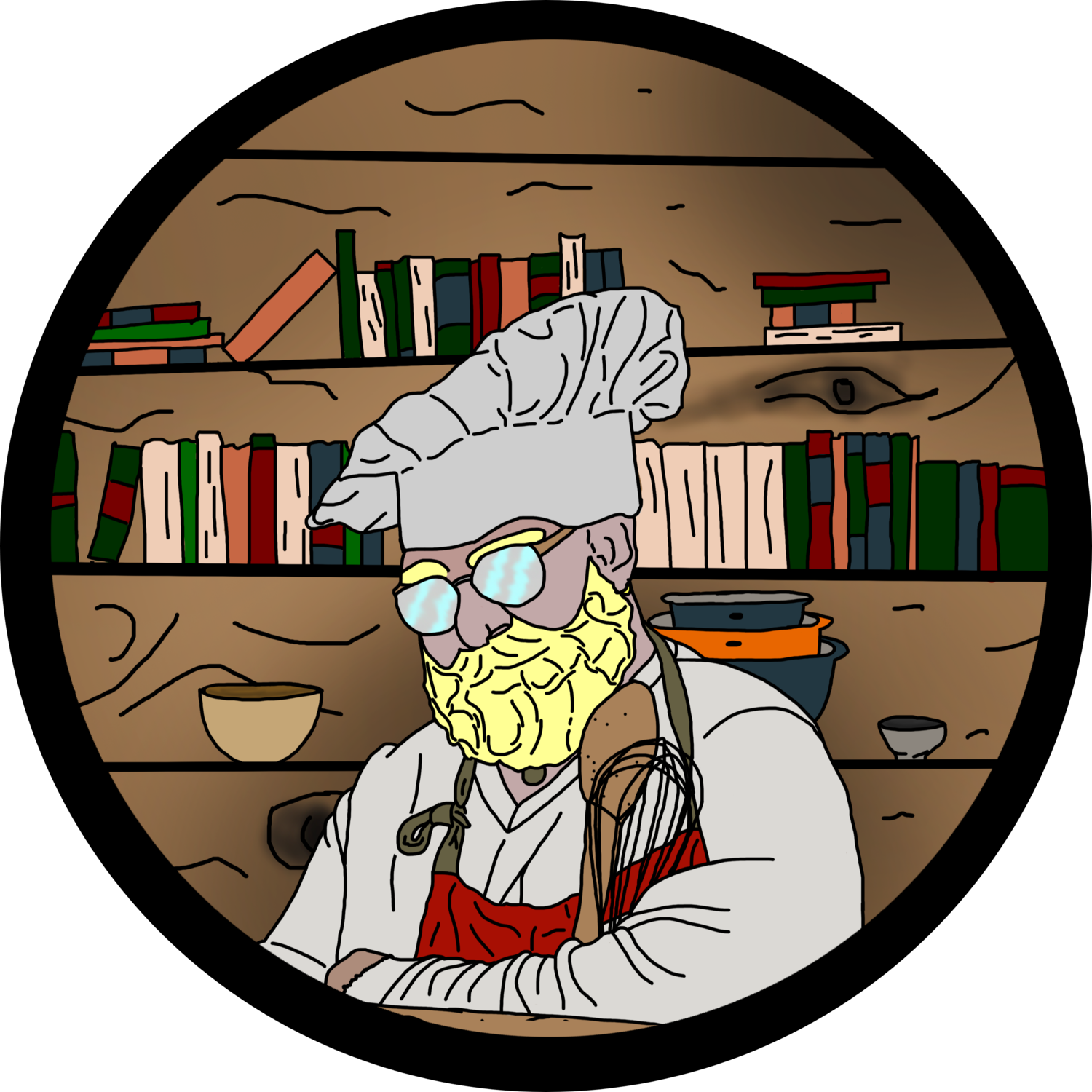
I’m now wondering if my “magic in the margins” should evolve into doodles of sugar-starved students with eyes bulging from two much fresh ginger, or Nels twirling on her back paws as the air around her swirls with hints of sizzling bacon, or a coven of Pictish Pastry Chefs enchanting their latest batch of Scottish dragon embossed Lemon Chili Pepper Shortbreads.
I think it’s time to sharpen my colored pencils!
Professor Butter Beard’s Lemon Chili Pepper Shortbreads
35-40 cookies
3 1/2 cup all-purpose flour
½ tsp fine sea salt
1 ½ tsp chili powder
½ tsp freshly ground black pepper
12 ounces (3 sticks) unsalted butter, room temperature
1 1/2 cups confectionary’s sugar
Zest of five large lemons
2 tsp vanilla paste
1 cup granulated sugar rolling before the bake
1) Preheat your oven to 325 degrees and line four sheet pans with parchment paper.
2) In a medium bowl, whisk together the flour, chili powder, black pepper and salt. Set aside.
3) Place the confectioner’s sugar and lemon zest in the bowl of a standing mixer and mix together until the zest is evenly distributed.
4) Add the room temperature butter, breaking the sticks into 1” pieces. Mix at medium speed until the mixture is creamed smooth and silky, about 5-6 minutes. Mix in the vanilla paste.
5) Add the dry mix all at once. Mix together at a low speed until the mixture forms a dough. Do not overmix.
6) Using a 1½ Tbsp scoop, portion the dough into roughly 35-40 balls. Roll each of them in the granulated sugar to fully coat.
7) Place 12 cookie balls onto each of the parchment-lined pans. Dip your cookie press in granulated sugar, shake it off and press the ball into a ¼” disc, impressing the design.
8) Bake one pan at a time on the center rack for 8 minutes, rotate the pan and bake for another 6 minutes until the edges of the cookies are just beginning to brown. While one pan bakes, prepare the next dozen for baking.
9) Cool the cookies on the sheet pan for five minutes before removing to a wire rack to cool completely.
