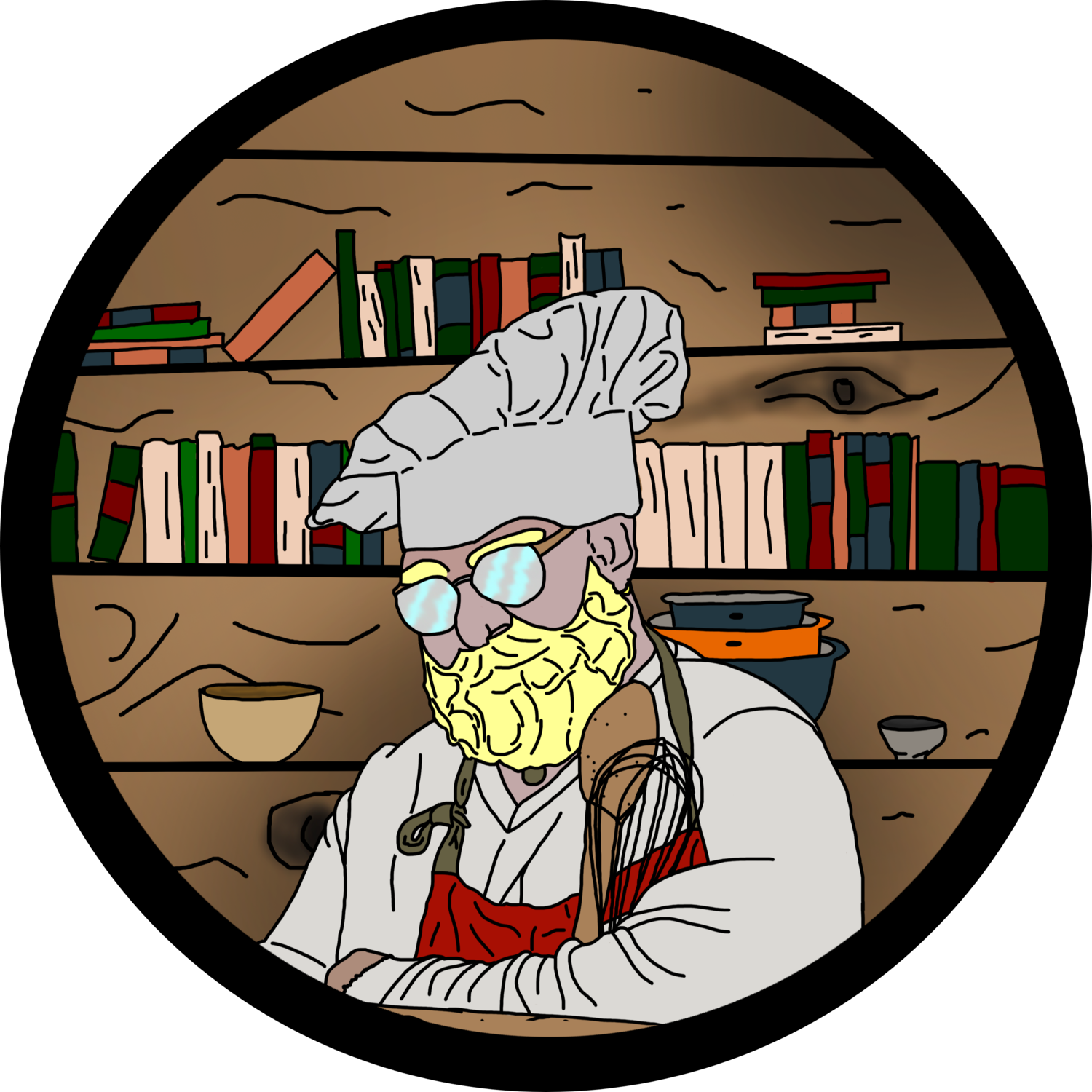
“no one creates . . the artist assembles memories” - Jack Butler Yeats
Jack Buter Yeats painted Irish memories. I bake them.
But let’s begin this conversation with Yeats.
Jack Butler Yeats was born in London, England, the youngest son of the Irish portraitist John Butler Yeats and the brother of W. B. Yeats (William Butler), who received the 1923 Nobel Prize in Literature. He grew up in Sligo (on the west coast of Ireland) with his maternal grandparents, before returning to his parents’ home in London in 1887. Yeats attended the Chiswick School of Art with his sisters Elizabeth and Susan, learning (in his own words), “Freehand drawing in all its branches, practical Geometry and perspective, pottery and tile painting, design for decorative purposes – as in Wall-papers, Furniture, Metalwork, Stained Glass.”
According to his family, Yeats’s favorite subjects included the Irish landscape, horses, the circus and travelling players – all from memory. His early paintings and drawings are distinguished by an energetic simplicity of line and color, and his later paintings by an extremely vigorous and experimental treatment of often thickly applied paint in an Impressionist manner. He frequently abandoned the brush altogether, applying paint in a variety of different ways, and was deeply interested in the expressive power of color. Despite his reputation as one of the most important Irish artists of the 20th century (and the first to sell for over £1m), he took no pupils and allowed no one to watch him work – a truly private and unique figure.
“Working predominantly in oils,” writes Jenny O’Gorman for HASTA, “ his lyrical paintings pay homage to Irish history, customs and lifestyle, whilst evoking a palpable sense of nostalgia. Like his brother, his artistic oeuvre is testament to the profound impact the Wild Atlantic Way had on him - a place that would remain with him for the rest of his life.”
Jack Yeats’s first book collection, “Life in the West of Ireland,” published in 1912, was composed of forty illustrations in a range of mediums, featuring colored prints to reprints of his oil paintings. Through works such as “The Country Shop,” the artist depicted the traditions, customs and local characters of rural Ireland at the turn of the century. Yeats wrote in his introduction, that through his work, he felt “impelled to pass on a memory or moment to his fellows, and to those that come after him.”
Painted in 1921, “Pilot Sligo River,” features a man in a peaked cap and double-breasted marine jacket standing at the quayside. It has been suggested by Yeats’s family that the pilot, who features in several other paintings, was based on Michel Gillen, a figure in Yeats’ childhood. Due to his grandfather’s connection with merchant ships, the young boy would often accompany the pilot on his journeys to guide vessels into Sligo.
“This nautical pilot’s relaxed but watchful frame,” continues O’Gorman, “dominates the foreground of the canvas, perhaps signifying that he occupied a heroic position in Yeats’ memory.” As the image has been painted in the studio from memory, there is an absence of recognizable detail, yet Yeats captures the essence of his character by evoking his ruddy complexion and salt-and pepper facial hair. Color is used vigorously. I believe this figure, this “pilot,” is seen through a “prism” of Yeats’s memory.
Swirling waves of yellow feature on his jacket and tinge the sky and sea. The figure appears to be melting into the blustery seascape - streaks of ochre, blue and crimson on his trousers give the impression he is becoming part of the very path behind him. Yeats places the viewer exactly into the Sligo landscape, painting local recognizable rowing boats in the right-hand corner, and placing a row of houses fading into the lifting morning fog of the background.
“We get a sense of the elemental forces which have shaped both the man and the soft Irish coastline; it is clear both were beloved by the artist,” writes O’Gorman.
As I studied the memories of Yeats this week, my own mind journeyed back to Ireland, specifically Dublin, and the adventures Colin, Katie and I shared on our graduate studies “spring break” dancing among the leprechauns. One morning, while my conspirators further enjoyed their limerick-filled dreams, I sunk into a corner booth of the hotel’s lounge, opened my current novel-of-choice, and ordered an espresso. It arrived with a chef’s gift – two thick slices of toasted soda bread, studded with crisp bacon and brisk Irish cheddar, and deliciously dripping with a slab of homemade butter. I can still taste every crumb.
I bake memories. For, “Sometimes, it isn’t just what the taste is like, but what the taste reminds us of that is the attraction.” – Meik Wiking.
Professor Butter Beard’s Bacon and Cheddar Irish Soda Bread
2 loaves
14 ounces cured bacon, cooked well-done and coarsely crumbled
6 ½ cups all-purpose flour
2 tsp baking soda
1 tsp Kosher salt
½ tsp freshly ground black pepper
¼ cup dark brown sugar
8 ounces strong cheddar, grated
2 ½ cups buttermilk
¼ cup cool water
1) Preheat the oven to 425 degrees and prepare two loaf pans with cooking spray and parchment paper inserts.
2) Cook the bacon (either in the oven or in a sauté pan) until well-done. Set aside to cool on a paper towel-lined plate. When cool, coarsely crumble the bacon. Set at the ready.
3) In a large bowl, whisk together the flour, baking soda, Kosher salt, black pepper and dark brown sugar.
4) Grate the cheddar cheese and fold into the dry mix. Then fold in the bacon crumbles.
5) Whisk together the buttermilk and water. Make a well in the dry mix and pour in the wet. Gently fold together to make a soft dough.
6) Carefully turn the dough out onto a flour-lined surface and divide the dough into two equal portions. Shape them into loaves and lay them into the prepared pans. Gently flatten the surface and lightly sift the tops with flour. Cut slashes into the tops with scissors. I suggest creating three X’s (XXX).
7) Bake on the center rack of the oven for 30 minutes. Rotate the loaves and bake for an additional 5-7 minutes to even the color.
8) Remove the loaves from the oven. Let them cool on a wire rack for 10 minutes. Tip them from the pans, remove the parchment paper, and let the loaves cool on the wire rack to room temperature.
