Professor Butter Beard and Gainsborough’s “Portrait of Sarah Hodges”
“Put even the plainest woman into a beautiful dress and unconsciously she will try to live up to it. It is as if for her the designer has created a new personality; her every movement reflects increased self-confidence, a new joy of living.” – Lucy, Lady Duff-Gordon, British Fashion Designer, 1932
Thomas Gainsborough, one of the founding members of the British Royal Academy, was, without doubt, one of the leading portraitists of the later 18th century. “In contrast to his great rival, Sir Joshua Reynolds,” writes Axel Ruger, Director of the Frick Collection, “whose portraits made reference to classical staties or grand historical events, Gainsborough captured the personalities of his sitters through the elegance, movement, and sensory qualities of the fashionable garments in which they presented themselves.”
Gainsborough was born in Sudbury, Suffolk, the youngest son of John Gainsborough, a weaver and maker of woolen goods, and his wife Mary, sister of the Reverend Humphry Burroughs. The young artist originally trained in London and, in 1746, he married Margaret Burr, an illegitimate daughter of the 3rd Duke of Beaufort. The artist's work, then mostly consisting of landscape paintings, was not selling well. In 1752, he and his family, now including two daughters, set up in practice in Ipswich with high hopes of attracting many new clients for his portraits.
In 18th century Britian, portraiture and fashion were inextricable from each other. Aimee Ng, curator of the current Gainsborough exhibition at the Frick, writes, “What to wear in a portrait was a chief concern for patrons, who were paying good money to look their best for posterity.”
It was also a challenge for the artists. Gainsborough believed that clothes could make or break a portrait. He wrote to Lord Dartmouth in 1771 that his wife’s “picture will look more like her and not so large when dressed properly in the latest fashion.”
He continued, “I am very well aware of the objection to modern dresses in pictures, that they are soon out of fashion and look awkward; but as that misfortune cannot be helped, we must set it up against the unluckiness of fancied dresses taking away likenesses, the principal beauty of intention of a portrait.” It has been documented that Gainsborough was often charged with revisiting and repainting his completed portraits to update styles that had gone out of fashion!
But back to the artist’s time in Ipswich.
Sarah Hodges (1737-1770) was the only child and heir of Thomas Hodges, Esq. and Sarah Peacock of Ipswich. This portrait is one of the last that Gainsborough painted there before moving his family to the fashionable summer spa town of Bath in 1759. Thomas Hodges may have commissioned it to celebrate his daughter’s twenty-first birthday.
“It’s imagery,” writes Ng, “symbolizing the sitter’s blossoming youth with a rosebud in her hand and a rose unfurling in the bush at left suggesting the promise of maturity, would have been suited to a portrayal of an unmarried heiress.” Sarah wed Captain William Innes in 1766, just seven years later, and then tragically died in 1770 at age thirty-three, shortly after the birth of her second daughter.
In her portrait, she gazes directly at the viewer, simply adorned with a black choker and white feather pompom on her natural hair. Elaborate mile-high coiffeurs were still the latest and greatest in female fashion. It is the blue watered-silk dress, á la française, characterized by pleated fabric cascading from the neckline at the back, and its front opening covered by a stomacher (triangular piece of fabric) decorated with blue scalloping, that steals the show.
“Put even the plainest woman into a beautiful dress and unconsciously she will try to live up to it.”
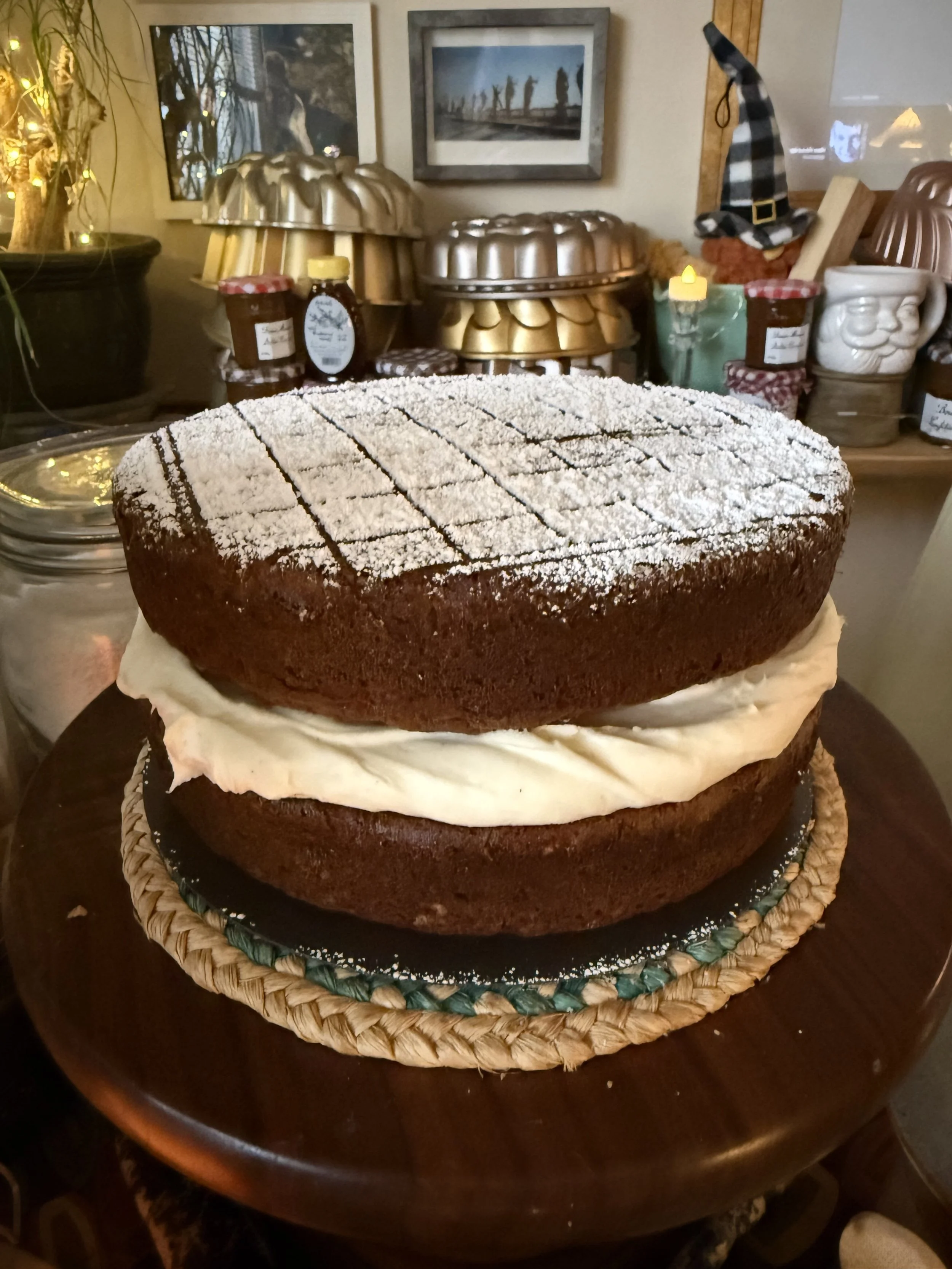
The thought of putting even the “plainest” into a beautiful dress danced in my culinary dreams this week. The often-neglected parsnip is an absolute favorite of mine. My grandparents planted the “white carrots” in the spring, but didn’t harvest them until the following spring, allowing them to concentrate their sugars while sleeping, buried under the winter snow. The moment the daring shoots broke ground, it was time to unearth the delectable roots and bake them into savory cheesy casseroles or sweet cakes complimented with warming spices, resurrected dried fruits, and simply adorned with a silken layer of scrumptious vanilla bean cream cheese frosting.
The perfect way to sweetly request Spring’s relief as we wake tomorrow to greet another foot and a half of Winter’s final snow.
Professor Butter Beard’s Springtime Parsnip Cake
1 cup golden raisins, soaked overnight (I prefer to use apple cider)
3 cups grated parsnips
2 cups all-purpose flour
2 tsp baking powder
2 tsp baking soda
2 tsp Chinese 5-Spice Powder
1 tsp fine sea salt
1 cup granulated sugar
¼ cup brown sugar (I prefer dark)
Zest of two oranges
¾ cup vegetable oil
¼ cup reserved soaking liquid
4 large eggs, room temperature
1 tsp vanilla paste
Frosting:
6 Tbsp unsalted butter, room temperature
8 ounces cream cheese, room temperature
½ cup confectioner’s sugar (plus more for dusting the top of the cake)
Vanilla bean paste and a dash of fine sea salt to taste
1) The night before, soak the golden raisins in enough liquid to cover (I prefer apple cider). When ready to bake, strain the raisins (set aside) and reserve the soaking liquid.
2) Prepare two 8” pans (butter and parchment paper) and preheat your oven to 375 degrees.
3) In a medium bowl, whisk together the flour, baking powder and soda, Chinese 5-Spice and salt. Set at the ready.
4) Grate the parsnips (usually 3-4) into another bowl and have at the ready.
5) In the bowl of a standing mixer, combine the granulated and brown sugars. Mix to break up any lumps. Add the zest and mix to combine. Add the vegetable oil, ¼ cup of the reserved soaking liquid, the four eggs and the vanilla. Mix until smooth.
6) Add the dry mixture, grated parsnips and raisins. Mix on medium speed to combine. Finish with a final fold using a spatula.
7) Evenly divide the batter between the two pans and bake for 20-25 minutes until just golden and puffed. Let the cakes cool in the pan for 10 minutes then turn onto a wire rack to cool completely.
8) For the frosting, mix all the ingredients with a standing mixer until smooth. Place one cake on your serving plate, spread all the frosting on the one layer. Top with the second later, flat side up, and slightly press together. Sift confectioner’s sugar on the top to decorate.