“I was chucked out for bad work and poor attendance, or for dressing as a female student dressed in black and holding an open umbrella, or perhaps both.” – William Nicholson, when asked about his exit from the Herkomer Art School.
Just another day in the life of a college freshman? But a spark silently dreams inside each and every one of them and it is the joy of the adventure to discover and ignite that hibernating jewel that brings me back to the podium every afternoon. And I applaud the mentor that encountered and natured that flame inside William Nicholson.
William Newzam Prior Nicholson was born in Newark-on-Trent, England in 1872. He was the youngest child of William Newzam Nicholson, an engineer for the Trent Ironworks, and later MP for Newark, and his second wife, Ann Elizabeth Prior, of Woodstock, Oxfordshire. At the age of sixteen, Nicholson entered Hubert von Herkomer’s art school at Bushey. There he met fellow students Mabel Pryde, who was to become his first wife, and her brother, the artist James Pryde.
Nicholson left Herkomer’s in 1891 following what Herkomer termed “a piece of Whistlerian impudence” (referencing the American artist James Whistler). William had dared to pose a nude model with an open umbrella and submit his “naughty” sketches as part of his mid-term exam.
In figure, the young Nicholson was slight and graceful and reportedly very agile. His friend Gordon Craig described him as “skillful beyond words in handling anything where eye and hand and brain have to be under perfect control, and in absolute harmony.” Nicholson’s son, the painter Benjamin Lauder Nicholson, wrote that his father dressed with meticulous but unconventional fastidiousness. “His wardrobe,” wrote Benjamin, “was famous for its delicately spotted shirts and dressing gowns, canary-yellow waistcoats and immaculate white trousers - worn also for painting.”
From 1893 to 1898, Nicholson collaborated with his brother-in-law James on poster design and other graphic work including signboard painting and book illustration. They called themselves the “Beggarstaffs,” or “J&W Beggarstaff.” In 1897, Nicholson provided woodcut illustrations and a cover design for “An Alphabet by William Nicholson,” including a self-portrait for “A is an Artist.” He also illustrated several of the early books of his son-in-law Robert Graves and “The Velveteen Rabbit,” a book for children by Margery Williamsand.
After the turn of the century Nicholson concentrated on painting, and portrait commissions were his main means of support. He wrote that his early still life and portrait paintings had affinities with both James Whistler and Édouard Manet, but that he did not respond well to later French Impressionist painting. Beginning in 1910, his palette suddenly lightened and his handling became freer, more experimental, a concentration on the play of light on a lustrous surface.
“As an artist,” writes Simon Martin, “Sir William Nicholson was primarily concerned with the act of observation. He was able to represent the gleam of a reflection in a lustrous vessel in the most understated, yet lyrical manner: capturing the momentary fall of light, but somehow also making it timeless.”
Ceramic and metal jugs were an important part of Nicholson’s life and adorned the surroundings in which he lived (a passion both the artist and I share). Benjamin wrote, “But of course I owe a lot to my father – especially his poetic ideal and his still-life theme….from the beautiful striped and spotted jugs and mugs and goblets…which he collected. Having those things throughout the house was an unforgettable experience for me.”
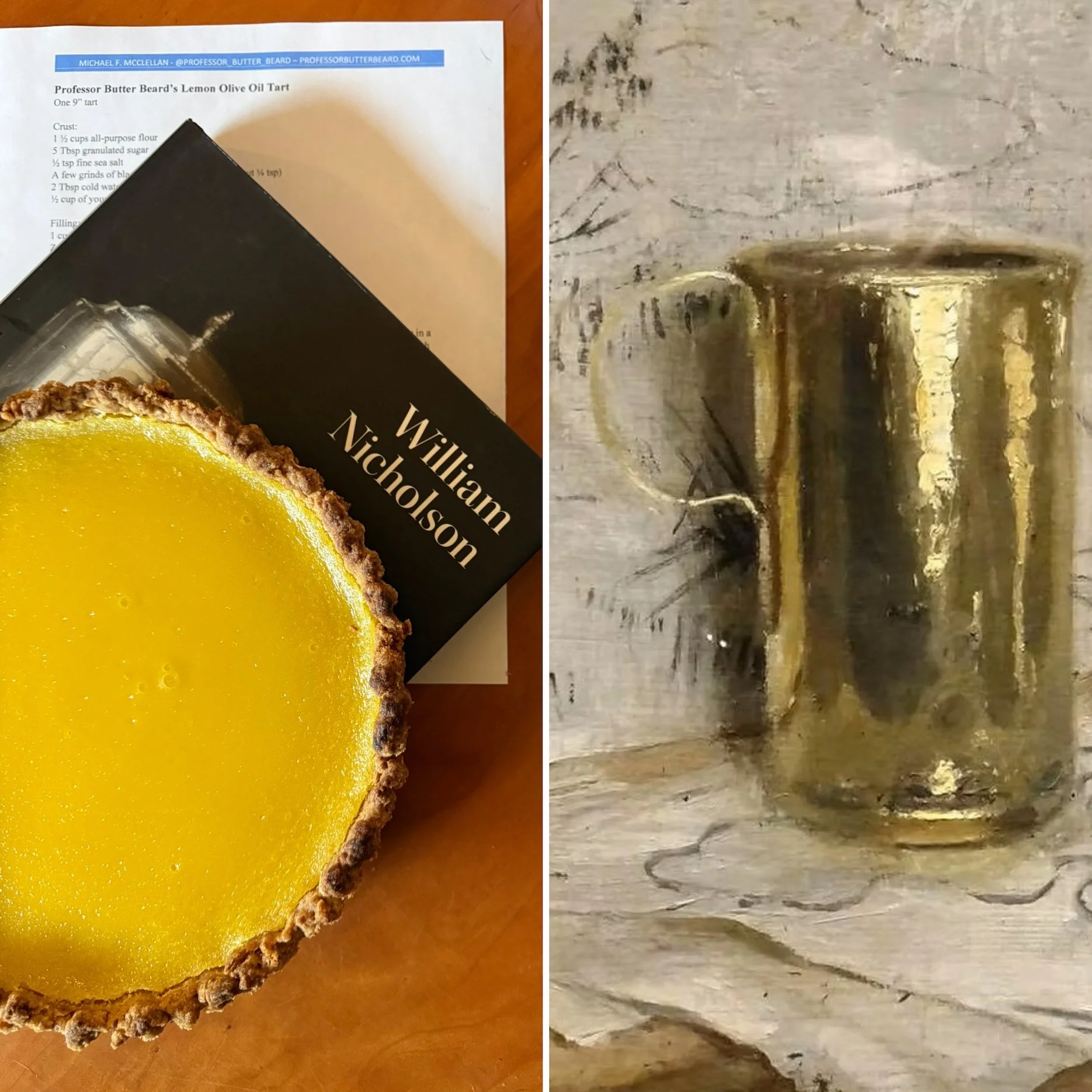
In 1937, Nicholson painted “Gold Jug,” although later thought to more likely depict a brass measure than a gold jug or mug. Melanie Vanderbrouck writes, “The metallic glint of the central object, oozing with light, seems almost liquid. Its effect is rendered most remarkable by the contrast with the almost abstract background loosely sketched in chalk and charcoal with the outlines of a landscape, leading the viewer to see the painting to become, in effect, a portrait of a regal entity in a glade. A landscape, portrait and still life all at once.”
All these observations of glimmering golden luster inspired me to capture the early-Spring sun’s welcome gleam within a lemon curd tart, infused with the warmth and sheen of Spanish olive oil and the unexpected floral burst of fresh thyme. Nicholson wrote, “the business of an artist practicing realism is to communicate what in the natural is irresistible to him and what in the act of communication in a particular medium is pleasurable.” May you taste as much irresistible pleasure in your second slice as I do.
Professor Butter Beard’s Lemon Olive Oil Tart
One 9” tart
Crust:
1 ½ cups all-purpose flour
5 Tbsp granulated sugar
½ tsp fine sea salt
A few grinds of black pepper (to taste, I like about ¼ tsp)
2 Tbsp cold water
½ cup of your best olive oil
Filling:
1 cup granulated sugar
Zest of one lemon
2 Tbsp all-purpose flour
¼ tsp fine sea salt
3 large eggs plus 3 large yolks
Juice of three lemons to equal ½ cup liquid
¼ cup of your best olive oil
1) Preheat your oven to 350 degrees. Whisk the flour, sugar, salt and pepper together in a medium-size glass bowl. Add the water and oil and fold together until a uniform dough forms. Crumble ¾ of the mix into the bottom of a 9” tart pan with a removable bottom. Press dough to an even thickness in the bottom of the pan. Crumble the remaining ¼ of the dough around the edges and press up the sides of the pan. Bake the crust for 30-35 minutes, rotating halfway through.
2) While the crust is baking, whisk the sugar and lemon zest together in a medium saucepan. Whisk in the flour and salt. In another small bowl, whisk together the eggs, additional yolks and the lemon juice. Add the egg mixture to the sugar mixture and whisk lightly until fully combined. Place the saucepan on medium heat, and while whisking constantly, bring the mixture to 160 degrees. Remove from the heat and whisk in the ¼ cup olive oil. Strain the curd through a fine mesh strainer set over a bowl.
3) Remove the crust from the oven and pour in the curd. Return to the oven and bake 8-12 minutes, just until the filling is set and barely jiggles when shaken. Let the tart cool on a wire rack for at least two hours before removing the metal ring.
Note: When in season, I add 1 tsp of fresh thyme leaves to the strained curd before baking in the crust.
