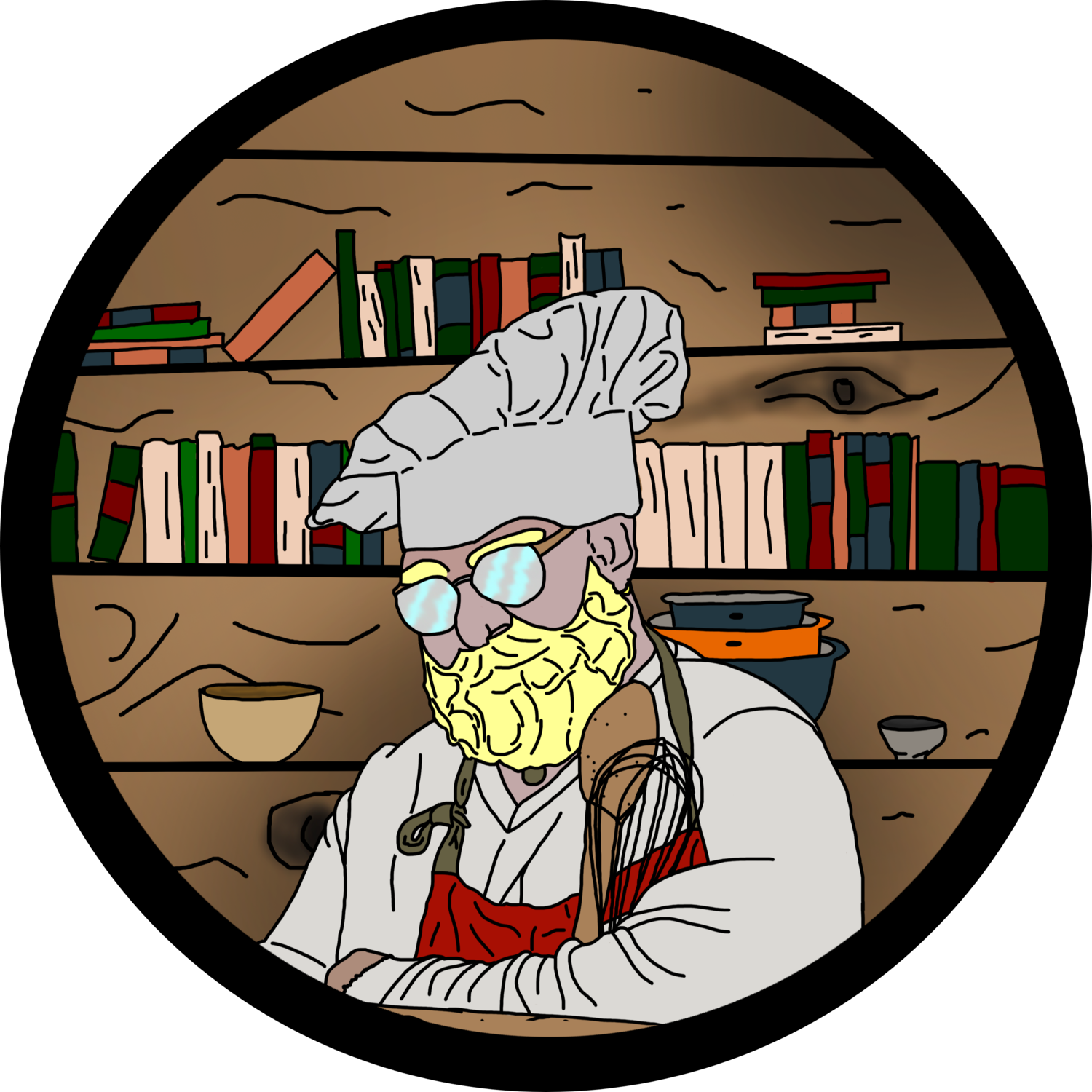
Professor Butter Beard and Etruscan Pottery
“Firing pottery is like lighting a fire in your heart.” – Yeon Somin, “The Healing Season of Pottery”
I don’t know which is more financially dangerous for Professor Butter Beard – a used bookstore or a flea market. Within the sacred space of a bookstore, I can usually keep my interior librarian in check, limiting myself to one (or two, or three) purchases. But allow me untethered access within a flea market and I will unconsciously release my inner “hunter gatherer,” filling canvas totes with rolling pins, cast iron pans, linens and antique ceramic bowls and pots. It is an endearing compulsion (I hope). And for this, I blame my father and his brother.
They are/were both inspiring historians and collectors. My father allowed me to accompany him at a very early age to dig for cast-off ceramic jugs and smoking pipe bowls in the pottery cemeteries of our hometown. A visit with my uncle always did, and still does, include an early morning of flea markets (deliciously located next to the best Amish bakery in Ohio) and delightfully dusty used bookstores. You know the kind – where you have to set down your prized purchases and blow your nose before re-entering the sun-lit world.
Due to this unique and intense training, my home is literally both a library and a ceramic museum. I know and treasure each and every item in the collection. Especially the pottery. They are the artworks of my life, collected over fifty years, from my grandmother’s mixing bowls and pie plates to works from current ceramic artists and students. That reminds me. I should probably curate a catalogue!
It is special week each semester when I am privileged to combine this passion for everything terracotta and my admiration for the ancient Etruscan culture. They knew the power of pottery! Granted, they were master bronze-smiths who exported their finely crafted products throughout the Mediterranean, and also famous for their magnificent gold jewelry which was unsurpassed in the ancient world. But, for me, it was their understanding of native Tuscan clay and its malleable potential to capture their interior visions and bring them forward into the tangible world.
Thomas P. Campbell, Director and CEO of the Fine Arts Museums of San Francisco writes, “The Etruscans flourished between the Arno and Tiber Rivers in the region now known as Tuscany from the 9th to the 2nd centuries BCE, during the Iron Age. They were a sophisticated and prosperous society, mainly due to the international commercial relations with the Greeks, Celts, Phoenicians, Carthaginians, and, occasionally, Egyptians. Etruria, their homeland, was rich in metals (particularly copper, tin, and iron), and the Etruscans consequently found a lucrative market trading these products.”
“And yet,” writes Richard Daniel de Puma, also of the Fine Arts Museums, “their pottery is perhaps the most valuable indicator of the course of civilization, the most reliable record of progress or decline for the ancient cultures.”
According to Etruscan historians, the earliest Etruscan pottery dates from the 10th-8th century BCE, although even earlier examples have been found. Archeologists have labelled this early pottery “impasto” (‘mixture’ in Italian) because it is not refined or wheel made. Instead, it is hand built using coils or slabs of clay that have been beaten or rolled thin and then fired at a relatively low temperature for a long period of time.
As ancient knowledge increased with regards to Etruscan pottery construction, Caere (modern Cerveteri) grew into a major pottery production center known for creating very large, heavy vessels and braziers, which were used to warm an area or heat or cook food. The unrefined clay of the area is a type of impasto which was fired in an oxidizing kiln, always appearing reddish brown, hence the name red-ware.
Etruscan kraters were large, bowl-shaped vessels used for mixing wine with water, often in symposia or funerary contexts. Kraters, like braziers, were slowly turned on the potter’s wheel, and specific parts, specifically the collar, neck and base, were also produced on the wheel but joined later to the large belly.
Some of my favorite examples of Etruscan pottery (including terracotta sarcophagi) depict festive occasions in which men and women celebrate together both in life and death. “Based on this imagery and other evidence,” writes Campbell, “scholars have determined that Etruscan women enjoyed greater respect, rights and liberties than their Greek and Roman counterparts.” How wonderfully refreshing and inspiring during these challenging times in which we are surviving.
Speaking of inspiration, this weekend I received an early birthday gift of a terracotta cloche for baking bread which inspired me to create my first recipe to bake in this Etruscan-like terracotta brazier. Toasting the rye flour adds an exquisite nuttiness and amping up the freshly ground black pepper provides both a surprise and tickle on the palette, especially when the bread is toasted and slathered with butter. Of course, I did burn one of my fingers in the process, but we chefs know that every ounce of deliciousness demands a wee payment in return.
Bake some bread. Maybe start the dough before spending a glorious morning at a used bookstore or flea market. See you there!
Professor Butter Beard’s Black Pepper Rye Bread
1 large loaf
2 cups lukewarm water
2 Tbsp honey
1 tsp active dry yeast (or 2 tsp, if not using sourdough starter)
3/4 cup of your sourdough starter
1/3 cup rye flour, toasted and cooled
3 cups bread flour (have additional on hand as needed on a humid day)
2 tsp fine sea salt
1 ½ tsp freshly ground black pepper
1) In a quart-size glass measuring cup, whisk together the warm water, honey, yeast and starter. Let the mixture bloom for ten minutes.
2) Lightly toast the rye flour over medium heat, stirring constantly, until aromatic and honey colored. Set aside to cool.
3) In the bowl of a standing mixer, whisk together the two flours, salt and freshly ground black pepper. Switch to the dough hook and add the bloomed yeast mixture. Mix until a rough dough forms that “slaps” the side of the bowl. This is a very wet sticky dough.
4) Lightly grease a large glass bowl and scrape in the dough. Cover and let rise until doubled. This could be anywhere from 2-3 hours. Punch down the dough and let rise until doubled again.
5) Shape the dough into a round and place it into a proofing basket lightly dusted with flour. Cover and let rise again while the oven preheats.
6) Place your Dutch oven into your oven and preheat to 450 degrees.
7) When the oven is ready, flip the dough onto a 12” circle of parchment paper. Lightly dust the top of the loaf with flour (I prefer rice flour at this point). Decoratively score the top of the loaf.
8) Carefully remove the Dutch oven from the oven. Use the parchment paper to lower the dough into the pan. Replace the cover and bake for 25 minutes. Remove the lid and bake for another 20 minutes until golden brown.
9) Use the parchment paper to lift the bread out of the pan. Transfer the bread to a wire rack, slip out the parchment paper, and allow the loaf to cool completely before slicing.
